

In Villupuram area, many children from migrant, destitute, marginalized, and economically disadvantaged families do not have access to proper support system to ensure a continuous learning process, as their families are not mostly available to provide assistance to their needs, and are thus at risk of dropping out of school. According to the latest UDISE+ 2024-25 data, dropout rates increased sharply across all education levels, reaching around 3% at the primary and upper primary levels and 8,5% at the secondary level. This represent a worrying reversal for a state previously recognized for its strong school retention performance.
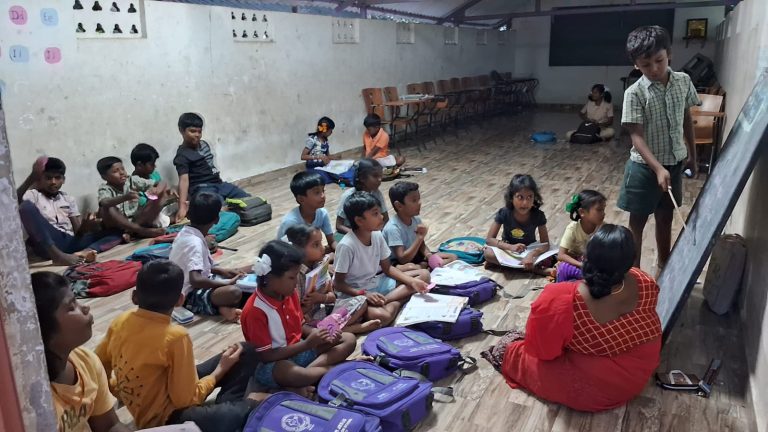
To address this issue, VCDS established in 2006 and currently operates twelve non-formal schools, providing two hours of instruction daily, from 5:30 to 7:30 pm., six days a week. The programme aims at improving the quality of basic education, reduce school dropout rates, bridge learning gaps, promote children’s participatory rights, and contribute to social transformation and community development. VCDS recruits mostly young women teachers from rural areas, providing thus a secure and continuous revenue. The programme provides supplementary education, promotes hild rights and equal educational opportunities, and helps children strengthen their foundational learning skills.
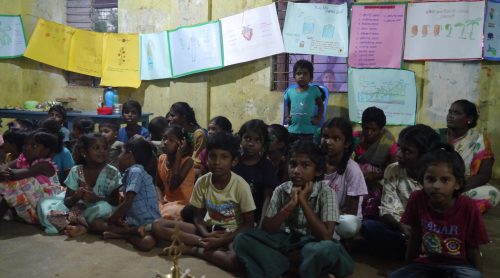
Sciences exhibitions are also regularly organized to boost students’ ability to think scientifically, to create and to exhibit their knowledge. In 2022, each fair featured more than 25 scientific process illustrations and more than 100 scientific drawings were exhibited, with the participation of more than 100 students. In 2026, VCDS also started STEM classes (Science, Technology, Engineering and Mathematics) for children. This aims at strengthening their curiosity, problem-solving abilities and digital literacy skills.
Overall approximately 550 children benefit from these twelve non-formal schools each year.
Parents are also regularly consulted through regular Parent-Teachers Association Meetings, where teachers share the students’ performance and behavior, and both parents and teachers share their opinion on the village’s issues (water, electricity, street lights etc.). There, parents look into the issues and find solutions or alternatives for the issues discussed.